Origins and meaning of the name
The name Huitzilopochtli derives from the Nahuatl words huitzilin (hummingbird) and opochtli (left), often interpreted as “Hummingbird on the Left” or “Left-Handed Hummingbird.” This designation reflects his association with the south, a cardinal direction linked to warfare and solar power in Aztec cosmology. The hummingbird, known for its agility and fierceness, symbolizes the souls of fallen warriors, believed to accompany the sun across the sky.
Mythological birth and cosmic battle
According to Aztec mythology, Huitzilopochtli was born under extraordinary circumstances. His mother, Coatlicue, became pregnant after a ball of feathers descended from the sky and entered her womb. This miraculous conception enraged her daughter Coyolxauhqui and her 400 brothers, the Centzon Huitznahua, who plotted to kill their mother to preserve the family’s honor.
Forewarned while still in the womb, Huitzilopochtli emerged fully grown and armed, wielding the Xiuhcoatl (“Fire Serpent”), a weapon symbolizing lightning and the sun’s destructive power. He defeated Coyolxauhqui, dismembering her and casting her head into the sky to become the moon, while her brothers became the stars. This myth encapsulates the daily struggle between the sun and the celestial bodies, reinforcing Huitzilopochtli’s role as the sun god who triumphs over darkness.
Patron deity of the Mexica and the founding of Tenochtitlán
Huitzilopochtli was the principal deity of the Mexica people, guiding their migration from the mythical land of Aztlán to the Valley of Mexico. He instructed them to settle where they would see an eagle perched on a cactus, devouring a snake—a vision that led to the founding of Tenochtitlán in 1325 CE. This symbol remains central to Mexican identity, depicted on the national flag.
As the patron god of Tenochtitlán, Huitzilopochtli embodied the city’s militaristic and imperial ambitions. His influence permeated all aspects of Mexica society, from politics and warfare to religion and daily life.
Iconography and symbolism
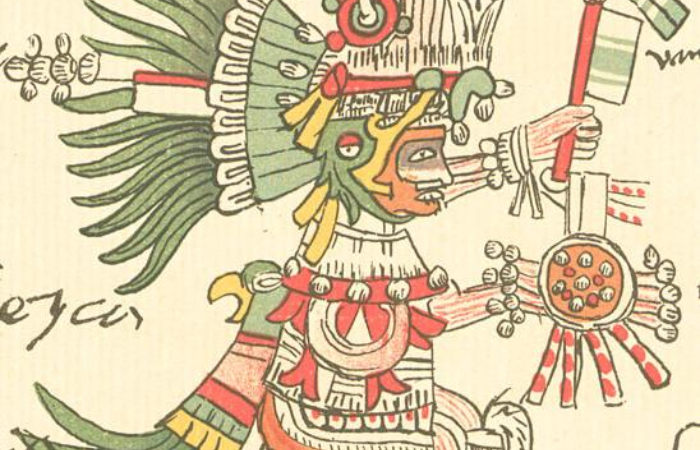
In artistic representations, Huitzilopochtli is depicted as a blue-skinned warrior adorned with hummingbird feathers, emphasizing his solar and martial aspects. He carries the Xiuhcoatl, symbolizing his power over fire and lightning, and a round shield representing the sun. His left leg is often shown as a serpent, further highlighting his connection to the Fire Serpent.
These symbols reinforce his role as a solar deity and a god of war, central to the Mexica worldview and their understanding of cosmic order.
Worship and rituals
The worship of Huitzilopochtli involved elaborate rituals, including human sacrifices, believed to nourish the sun and ensure its daily rise. Victims, often captured warriors, were sacrificed atop the Templo Mayor, the main temple in Tenochtitlán dedicated jointly to Huitzilopochtli and Tlaloc, the rain god. The heart of the victim was offered to the sun, and the body was cast down the temple steps, mirroring the myth of Coyolxauhqui.
These ceremonies were integral to Mexica religion, reflecting their belief in the cyclical nature of time and the necessity of sacrifice to maintain cosmic balance.
The festival of Panquetzaliztli
One of the most significant festivals honoring Huitzilopochtli was Panquetzaliztli, celebrated in the 15th month of the Mexica calendar. During this festival, elaborate ceremonies, dances, and sacrifices were performed to commemorate his birth and his victory over Coyolxauhqui. The festival reinforced social cohesion and the central role of Huitzilopochtli in Mexica society.
Legacy and cultural impact
The legacy of Huitzilopochtli endures in modern Mexico, symbolizing national identity and cultural heritage. The imagery of the eagle, cactus, and snake on the Mexican flag traces back to the founding myth of Tenochtitlán. Archaeological sites like the Templo Mayor continue to reveal insights into Mexica religion and the central role of Huitzilopochtli.
His story reflects the Mexica values of bravery, sacrifice, and the perpetual struggle between light and darkness, themes that resonate in the broader context of human history and mythology.